
THE TEN ESSENTIALS OF TAIJIQUAN
By Yang Chen Fu recorded by Chen Wei Ming
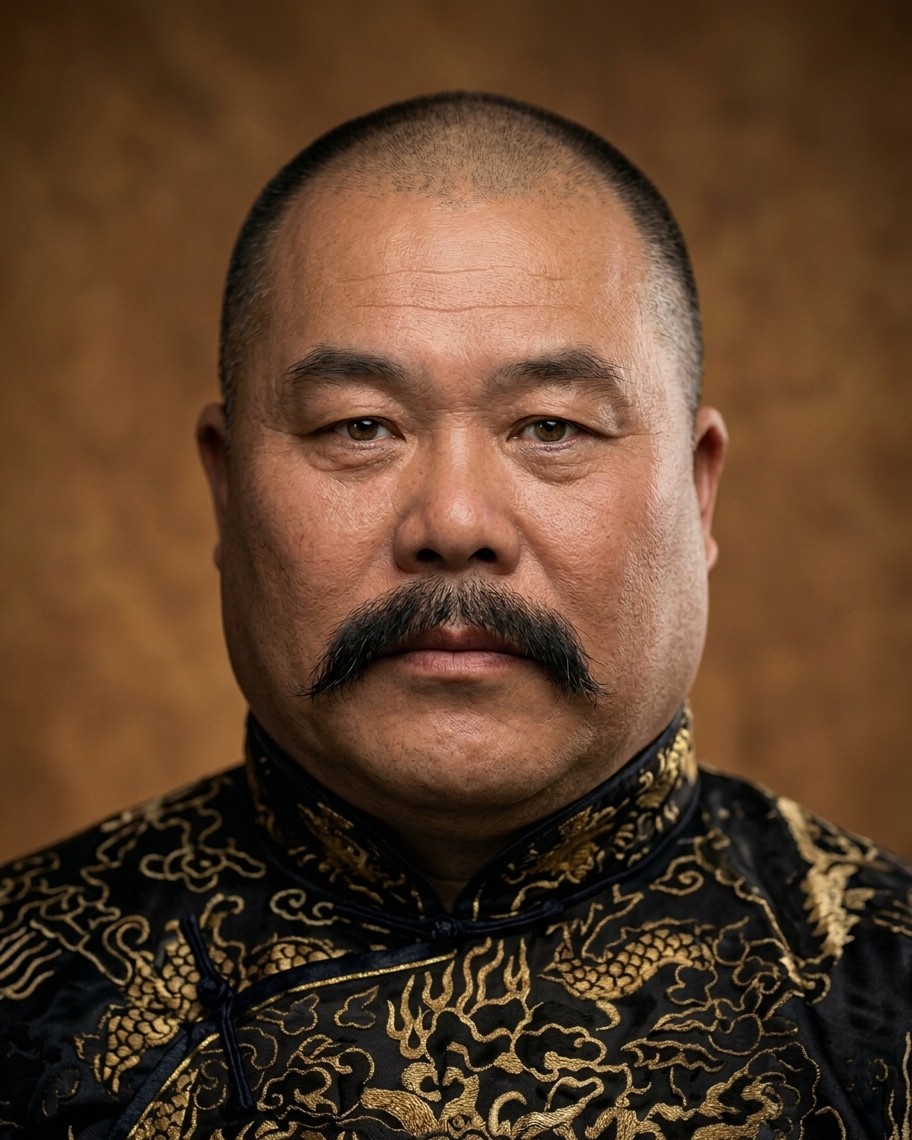
- Raise the head
An intangible and lively energy lifts the crown of the head. This refers to holding the head in vertical alignment in relationship to the body, with the spirit threaded to the top of the head. One must not use strength: using strength will stiffen the neck and inhibit the flow of qi and blood. One must have the conscious intent* of an intangible, lively, and natural phenomenon. If not, then the vital energy (jingshen) will not be able to rise.
The action of lifting the head by its crown helps elongate the spine. To perform this effectively, one must concentrate the mind on lengthening the spine (intent*). As the spine rises with the movement of the crown, natural spacings between the vertebrae are encouraged to open. Regular practice over time (no less than 6 months) creates elasticity of movement in each part of the body to which your attention is directed. Observing this increase in elasticity during Tai Chi practice enables the practitioner to become aware when parts of the body are stiffening and interfering with natural movement. Stiffening is a sign of the unnecessary use of “strength”.
2. Sink the Chest to open the Back
Contain (sink) the chest and raise the back.“Containing the chest” means to lower in the chest slightly to allow the qi to sink to the dantian. One must avoid rigidity in the chest; thrusting out the chest will cause blockage in the chest cavity. One will be heavy above and light below; the heels will float up. “Raise the back” means the qi adheres to the back. If one is able to contain the chest, then one will naturally be able to issue force from the spine, and you will be undefeatable.
Mindfully elongating the spine helps the upper chest muscles relax so that the chest naturally lowers. This in turn allows the upper back to open, which enhances the capacity of the lungs to expand outward, thereby enabling the upper back also to expand upwards and outwards.
Equally important is that, when force is applied to the front of the body, it can be received through the front of the body rather than be allowed to penetrate. Furthermore, with proper training and supervision, the development of elasticity in the upper back contributes to martial effectiveness.
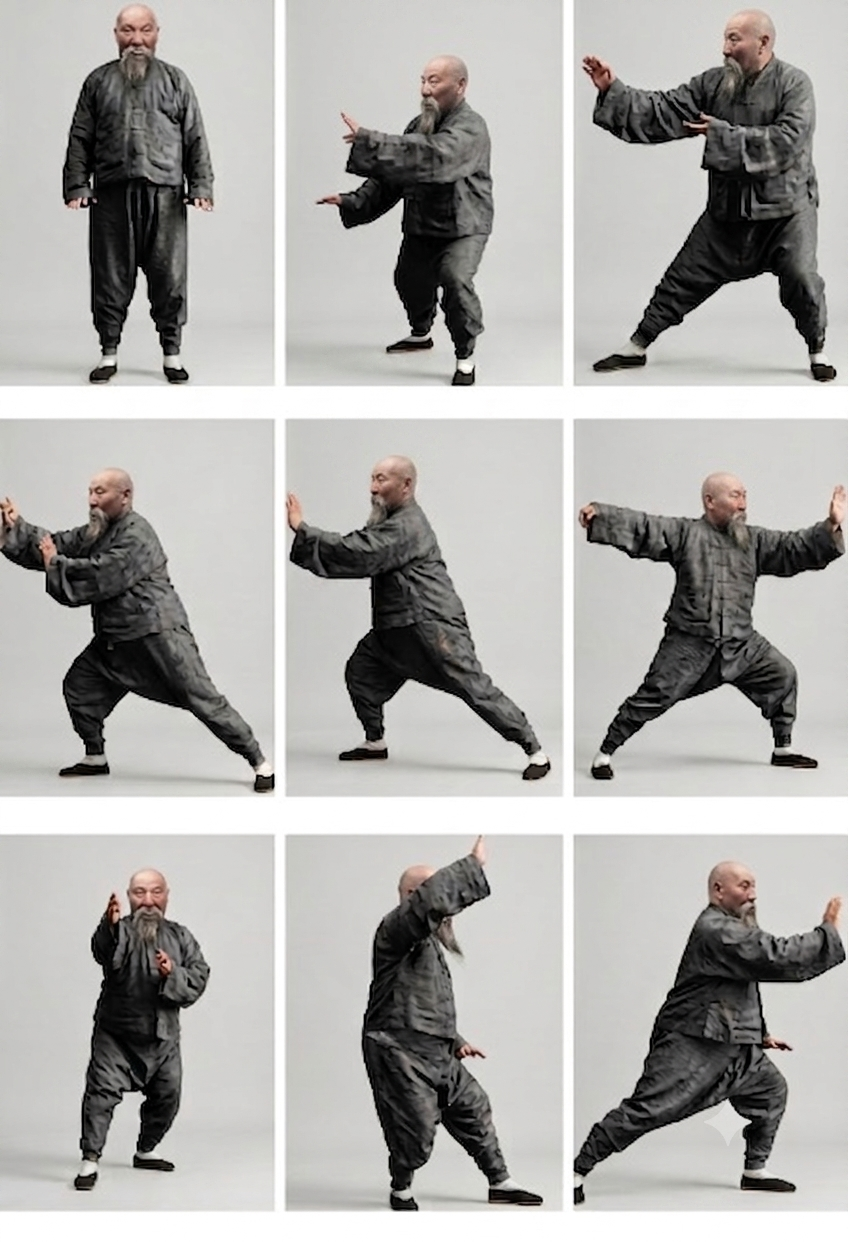
3. Relax the Waist and govern all movements with the waist
Relax the waist. The waist is the body’s ruler. If you are able to relax the waist, the two feet will have strength and the foundation will be stable. The changes of insubstantial and substantial all come from the turning movements of the waist, hence it is said, “The source of meaning is in the region of one’s waist.” If there is a situation in which you are unable to attain strength, you must seek the cause in the waist first.
The “waist” incorporates what is nowadays referred to as the ‘core’ or Dantien. In the Chinese tradition is also called the ‘elixir field’. It includes the pelvic floor, the obliques. The waist governs all movement occurring both above and below this area of the body. It learns how to do this by using forms practice and drills to increase the elasticity, strength and range of motion of the body’s core. Use of the term “relax” in this point draws attention to the need to free the waist movement from any restriction imposed by the hips below and the diaphragm/chest above.
4. Distinguish insubstantial and substantial. (Solid and empty)
Distinguish insubstantial and substantial. The art of Taijiquan makes the distinction between insubstantial and substantial as the first principle. If the weight of the entire body is placed over the right leg, then the right leg is substantial (full), and the left leg is empty. If the entire body’s weight is placed over the left leg, then the left leg is substantial, and the right leg is empty. If one is able to distinguish empty and full, then the body’s turning motions will be light and agile, and there will be no wasted strength. If one is unable to distinguish, one’s steps will be heavy and sluggish, one’s stance will be unsteady, and one will easily be unbalanced by an opponent’s pull.

5. Sink the shoulders and drop the elbows.
Sink the shoulders, means the shoulders are relaxed, open, and allowed to hang down. If one is unable to relax the shoulders and naturally allow them to hang down, they will rise up under pressure and the qi will also follow them up, thus the whole body will lack strength. “Dropping the elbows” means relaxing the elbows downward and letting them hang. If the elbows are drawn up, the shoulders will be unable to sink, and you will not be able to defuse force or uproot an opponent.
6. Use a conscious mind, not brute strength.
This is spoken of in the “Taijiquan Classics.” Use the mind/intent connected strength (Yi), not muscular strength (li). In practicing Taijiquan, the entire body is loosened (song) and open; avoid the use of hard crude force (excessive muscular tension) (Zhuo li), which causes blockage in the sinews, bones, and blood vessels, and causes one to be bound up.
Then you use the mind in the movements, they become light and agile in the changes of direction, and circular rotations will become free. Some doubt: without using strength, how can one increase one’s strength? Now, the human body has meridians – as the Earth has watercourses. When the watercourses are unblocked, the water flows. When the meridians are unblocked, then the qi passes through to the ground. If the whole body is stiff, the Jin fills the meridians, and the qi and blood become stagnant, and the turning motions are not nimble. If one hair is pulled, the whole body is moved. If one does not use strength but instead uses mind/intent (Yi), then where the Yi arrives, the Qi then follows. If the qi and the blood flow fully, daily threading and flowing through the entire body, there will be no time when there are blockages. After long practice, one then attains genuine internal strength. Hence the statement in the “Taijiquan Classics”: “Arriving at the extreme of yielding softness, one afterward arrives at the extreme of solid hardness.” The arms of those who are proficient in the skill of Taijiquan are like iron within cotton, and extremely heavy. When practitioners of external martial arts use strength, then their strength is evident. When not using strength, they are very light and floating. It is obvious that their strength remains as outward energy, as surface energy. When not using mind/intent (Yi) but using strength, it is very easy to be led in and uprooted.

7. Coordinate Upper and lower Body.
Upper and lower follow one another is what is referred to in the saying from the “Taijiquan Classics”: “Movement is rooted in the feet, issued by the legs, governed by the waist, and expressed in the fingers. From the feet, to the legs, then to the waist, always there must be complete integration and connection for one’s Qi to move naturally.” With the movements of the hands, waist, and feet, the focus of the eyes also follows these movements. When it is like this, only then can it be called “upper and lower follow one another.” Or if one part moves all parts move. If there is one part that does not move, then the form (movement) is scattered and confused.

Yang Ban Hou
8. Internal and external are united equally integration of the spirit.
Internal and external are united. What one trains in Taijiquan is the spirit, therefore it is said, “The spirit is the leader, the body follows its order.” If one is able to raise the spirit of vitality throughout the body, one will naturally be able to deport oneself lightly and with agility. The form (movements) is none other than empty, full, open, and closed. What is called ‘open’ is not only the opening of the hands and feet – the mind/intent also opens with them accordingly. What is called ‘closing’ is not only the closing of the hands and feet – the mind/intent also closes with them accordingly. When able to unite inner with outer as one, Jin Qi Shen unite with complete continuity.

Yng Zhou Pan
9. Continues movement linked together without breaks. One part moves all parts move.
Linked without breaks. With practitioners of external martial arts, their strength is contrived and crude force (hou tian zhi zhuo). Therefore, it has its starts and stops, its duration and cessation. When its called old strength is already depleted, its new strength has not yet been born.
At these times it is most easily overcome. Taijiquan uses the mind/intent, not strength. From beginning to end it is continuous without ceasing, a complete cycle to the beginning, circling without end. In the original teachings it is said: “Move Like the Long River, it flows smoothly on without ceasing.” It is also said, “Move the Jin (earth energy connected hand to foot, this is the same as a kinetic chain) as though drawing silk (from a cocoon).” These words refer to its being threaded together (Guan Chuan) all as one Qi.
10. Seek serenity in motion
The external martial arts view leaping and stumbling as ability. They employ exertion of qi and strength, so that after training they are invariably gasping for breath. Taijiquan uses stillness to manage movement. Even when there is movement, there is stillness. Therefore, in practicing the form, the slower the better. When practicing slowly, the breathing deepens and lengthens, the qi sinks to the dantian. One avoids the harm of straining the blood circulation. Students should carefully contemplate this so as to attain its meaning.

Ref: Fu Zhong Wen (1999) “Mastering Yang Style Taijiquan”. North Atlantic Books; Berkeley, California Translated by Louis Swaim expanded upon by Damon Bramich
Yin Yang theory
Yin and Yang are among the most recognizable concepts in Chinese philosophy, yet they are also among the most misunderstood. Many people know the symbol, the black and white circle with two swirling halves, but fewer understand what it represents or how it applies to Tai Chi. In this chapter, we explore Yin and Yang in a way that is simple, practical, and directly connected to the art you are learning.
Yin and Yang are not mystical forces or rigid categories. They are a way of describing how things change, how they relate to each other, and how balance is maintained in the natural world. Tai Chi uses this framework to help us understand movement, stillness, effort, relaxation, and the dynamic relationships that shape our practice.
This chapter provides the foundation you need to understand the deeper principles of Tai Chi. Later chapters will build on this understanding, showing how Yin and Yang appear in movement, structure, intention, and martial application.
Grasping the meaning of Yin and Yang
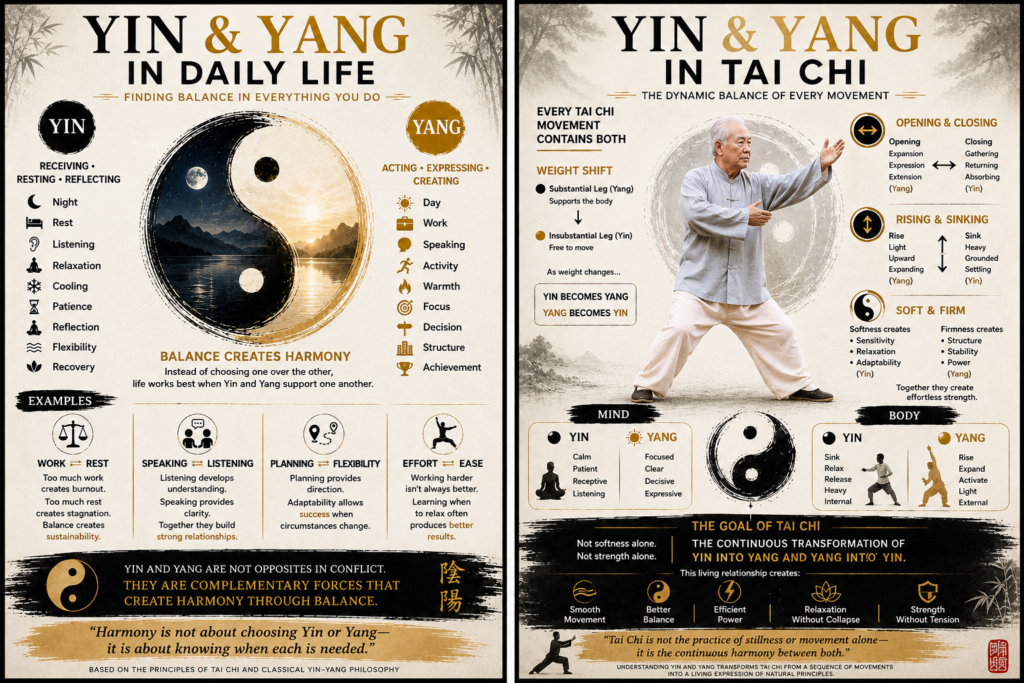
In its simplest terms, Yin and Yang describe complementary qualities that depend on each other. Yin is often associated with qualities like stillness, softness, coolness and inward movement. Yang is associated with activity, firmness, warmth and outward movement. But these associations are not fixed. In Tai Chi practice, Yin and Yang are always relative, always changing, and always connected.
Here are a few examples to help make this clearer:
• Night is Yin; day is Yang.
• Rest is Yin; action is Yang.
• Inhaling is Yin; exhaling (effort) is Yang.
• The inside of the body is Yin; the outside is Yang.
• In our practice we need to seek softness with Yin and structural firmness with Yang. We need to create a continuous flowing interplay of Yin and Yang that is holistic but also segmented in relationship to each moving section of the body.
This is the key to understanding Tai Chi: Yin and Yang are always transforming into each other. When one reaches its peak, it naturally gives rise to the other. This constant transformation is what keeps life in balance.
Yin and Yang are relative in relation to each other, but not absolute.
One of the most helpful things to understand is that Yin and Yang are relative terms. Something is Yin or Yang only in comparison to something else.
For example:
• Walking slowly is Yin compared to running, but is Yang compared to standing still.
• A cloudy day is Yin compared to a sunny day, but is Yang compared to nighttime.
• A soft movement is Yin compared to a punch, but is Yang compared to complete stillness.
This relativity is essential in Tai Chi. When we talk about one leg being “substantial” (full) and the other “insubstantial” (empty), we are describing a relationship. The substantial leg supports the weight; the insubstantial leg is free to move. But as soon as you shift your weight, the roles reverse. Yin becomes Yang; Yang becomes Yin.
This fluidity is what makes Tai Chi feel smooth and natural. Nothing is fixed. Everything is in motion, even when the body appears still.
Yin and Yang in nature
Yin and Yang are not ideas invented for martial arts. They come from observing nature. Early Chinese thinkers noticed patterns in the world: cycles of day and night, the changing seasons, the ebb and flow of tides, the rise and fall of energy in the body. They used Yin and Yang to describe these patterns.
Here are a few natural examples:
• Seasons: Winter is Yin: cold, quiet, inward. Summer is Yang: warm, active, outward. Spring and autumn are transitions between the two.
• Weather: Rain is Yin: cooling, softening. Sunshine is Yang: warming, energizing.
• Plants: Roots grow downward (Yin). Branches grow upward (Yang). A healthy plant needs both.
• Animals: Resting is Yin. Hunting or playing is Yang. Animals naturally alternate between the two.
Tai Chi draws from these natural rhythms. When we practice, we are not trying to just create moving shapes with the body. We are learning to move in harmony with the same principles that govern the natural world. This means we need to work with and embrace the rhymical interchanges of Yin and Yang during each section of each movement.
Yin and Yang in the body
The human body expresses Yin and Yang in countless ways. Understanding these relationships helps us practice Tai Chi with greater awareness and ease.
Yin qualities in the body:
• softness
• heaviness
• sinking
• inward focus
• relaxation
• cooling.
Yang qualities in the body:
• firmness
• lightness
• rising
• outward focus
• activation
• warming.
Neither Yin nor Yang is better. Both are necessary. Tai Chi teaches us to balance them so the body can move efficiently and comfortably. This is the essence of forming true softness into true hardness.
For example:
• When the legs sink (Yin), the spine naturally rises (Yang).
• When the breath settles (Yin), the mind becomes clearer (Yang).
• When the joints relax (Yin), movement becomes more powerful (Yang).
This interplay is what gives Tai Chi its unique feeling of being grounded and light, soft and strong, calm and alert.
Yin and Yang in movement
Tai Chi movements are built on the continuous alternation of Yin and Yang. Every posture contains both. Every transition expresses their transformation.
For example:
• Substantial and insubstantial: When one leg bears the weight (substantial), the other is free (insubstantial). This distinction prevents double-weighting and allows smooth stepping.
• Opening and closing: Opening movements expand outward (Yang). Closing movements gather inward (Yin). The Tai Chi form alternates between these phases naturally.
• Rising and sinking: Rising is Yang, light, upward, expansive. Sinking is Yin, heavy, downward, settling. These qualities give Tai Chi its wave-like flow.
• Fast and slow: Even in slow practice, there are subtle variations. A movement may slow down to gather (Yin) and then accelerate slightly to release (Yang).
• Soft and firm: Softness allows sensitivity and adaptability (Yin). Firmness provides structure and clarity (Yang). Tai Chi blends the two seamlessly.
When students first learn Tai Chi, they often focus on the external shapes. But as their practice deepens, the internal alternation of Yin and Yang becomes as important as the outer external shapes of each form. This is where Tai Chi begins to feel alive.
Yin and Yang in mind and emotion
Yin and yang are not just physical qualities, they also describe states of mind and emotion.
Yin states of mind:
• calm
• reflective
• receptive
• patient.
Yang states of mind:
• focused
• decisive
• expressive
• active.
Healthy mental balance requires Yin and Yang. Too much Yin can lead to passivity or indecision. Too much Yang can lead to tension or impulsiveness. Tai Chi helps cultivate a balanced mind by training us to shift smoothly between these states.
For example:
• When listening to a partner, we use Yin—quiet attention.
• When responding, we use Yang—clear intention.
• When learning a new movement, we begin with Yin—absorbing information.
• When performing it confidently, we express Yang—clarity and purpose.
This mental flexibility is one of the greatest benefits of Tai Chi. It teaches us to respond to life with both sensitivity and strength.
Yin and Yang in everyday life
One of the reasons Tai Chi is so valuable is that its principles apply far beyond the training hall. Yin and Yang can help us understand how to navigate daily life with more ease and balance.
For example:
• Work and rest: Working without rest leads to burnout. Resting without purpose leads to stagnation. Balance creates sustainability.
• Speaking and listening: Good communication requires Yin and Yang. Listening (Yin) creates understanding. Speaking (Yang) expresses clarity.
• Effort and ease: Pushing too hard creates tension. Not trying at all leads to drift. Balanced effort leads to progress.
• Planning and spontaneity: Planning provides structure (Yang). Spontaneous flexibility allows adaptation (Yin). Together, they create resilience.
Tai Chi helps us recognize when we are out of balance and teaches us how to adjust gently, rather than forcefully.
Yin and Yang are not moral judgements
A common misunderstanding is to think of Yin as “good” and Yang as “bad,” or vice versa. In reality, Yin and Yang are not moral categories. They are descriptive, not prescriptive.
For example:
• Softness is not better than firmness.
• Stillness is not better than movement.
• Yielding is not better than acting.
Each has its place. Each is appropriate in certain situations. Tai Chi teaches us to recognize what is needed in the moment and respond accordingly.
This is why Tai Chi is often described as a practice of harmony. Harmony does not mean avoiding conflict or always choosing the gentler path. It means responding in a way that fits the situation, maintains balance, and avoids unnecessary struggle.
The Tai Chi symbol (Taiji Tu)
The familiar black-and-white symbol is called the Taiji Tu, or “Diagram of the Supreme Polarity.” It visually expresses the relationship between Yin and Yang.
Here’s what it shows:
• The circle represents wholeness.
• The black half represents Yin.
• The white half represents Yang.
• The shapes swirl into each other, showing continuous transformation.
• Each half contains a dot of the other, showing that nothing is purely Yin or purely Yang.
The Tai Chi symbol is not just decorative. It is a teaching tool. When you look at it, you are seeing the entire philosophy of Tai Chi in one image: unity, balance, change and the interdependence of opposites.
Why Yin-Yang theory matters in Tai Chi
Understanding Yin and Yang is essential to Tai Chi practice because it gives meaning to the movements. Without this understanding, Tai Chi can become a series of empty gestures. With it, the practice becomes a living expression of natural principles.
Here’s why it matters:
• It helps you understand how to shift weight smoothly.
• It clarifies the difference between substantial and insubstantial.
• It explains why relaxation is more effective than tension.
• It guides the alternation between opening and closing.
• It supports the development of sensitivity and listening.
• It provides a framework for understanding martial application.
• It connects the practice to nature and daily life.
In short, Yin–Yang theory gives Tai Chi its depth. It transforms the practice from exercise into philosophy, from movement into meaning.
Yin and Yang as a lifelong study
Like Tai Chi itself, Yin and Yang are not concepts you learn once and then set aside. They are ideas that deepen over time. As your practice grows, your understanding of Yin and Yang will grow with it.
At first, students may[LR1.1] notice only the obvious contrasts—heavy and light, open and close. Later, they will begin to sense more subtle distinctions—internal and external, intention and expression, gathering and releasing. Eventually, Yin and Yang become less like concepts and more like sensations. You feel them directly in your body and mind.
This is the true value of Yin–Yang theory. It is not something to memorize. It is something to experience.
Please follow our website for regular updates on written content, video’s, training packages and upcoming workshops.
Click on the button below to learn more about Tai Chi Classes.
Click on the button below to get in touch.